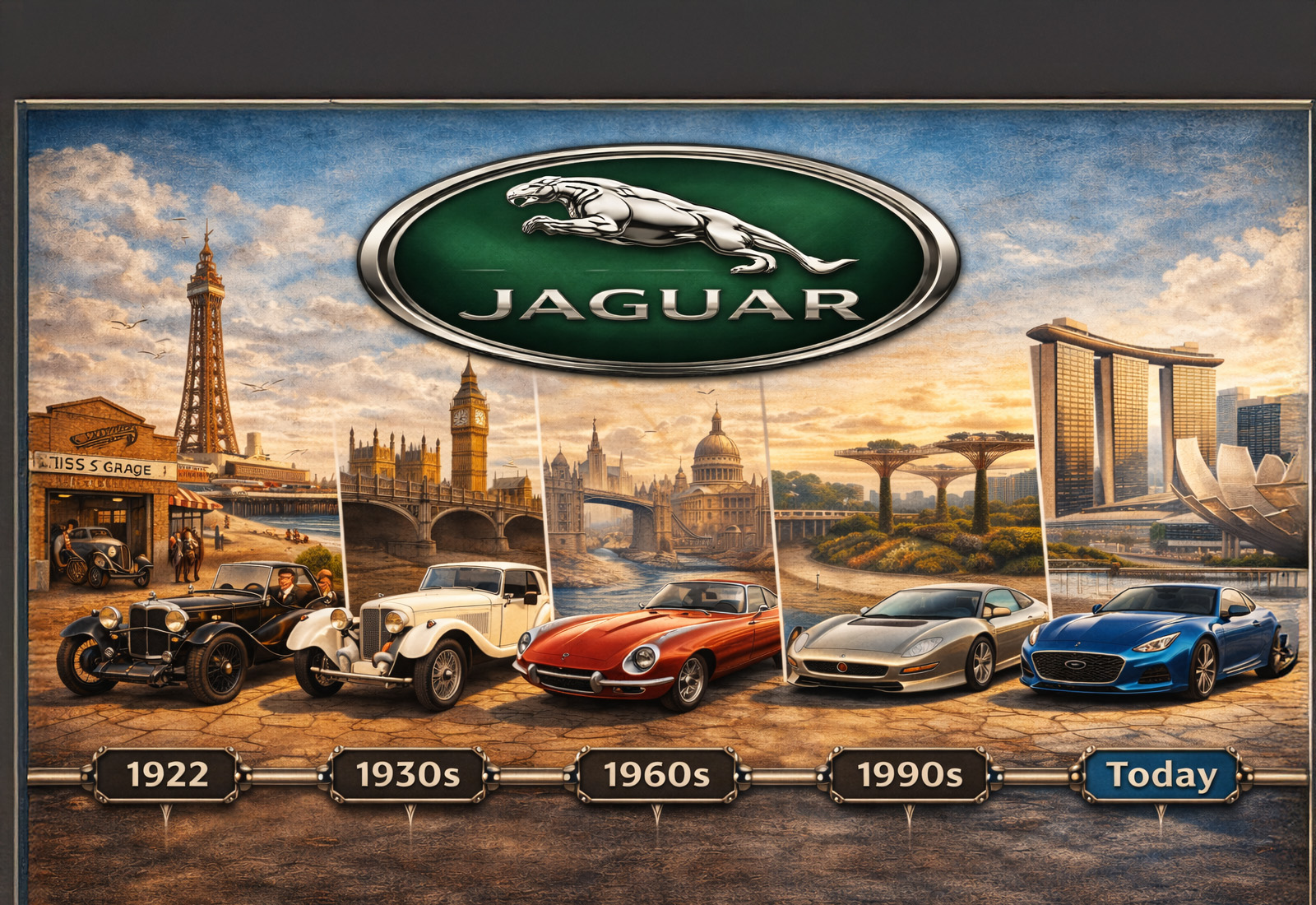
The story of Jaguar is one of reinvention, resilience, engineering brilliance, and bold ambition. From humble beginnings as a motorcycle sidecar manufacturer to becoming one of Britain’s most iconic automotive marques, Jaguar’s journey spans more than a century of innovation, racing triumphs, corporate upheavals, and technological transformation.
1922–1935
The Swallow Sidecar Company
1922 – Foundation
- Founded in Blackpool, England by William Lyons and William Walmsley.
- The company initially produced stylish motorcycle sidecars.
- Known as the Swallow Sidecar Company (SSC).
1927 – Move into Car Bodies
- SSC began building custom car bodies on Austin Seven chassis.
- Focused on style and affordability.
- Company relocated to Coventry, the heart of British automotive production.
1931 – First SS Cars
- Introduction of the SS1 and SS2.
- First complete cars developed under the Swallow name.
- Stylish, low-slung designs at competitive prices.
1935–1945
Birth of the Jaguar Name
1935 – The Name “Jaguar”
- Introduction of the SS Jaguar 2½ Litre saloon.
- “Jaguar” becomes the model name, symbolising speed and elegance.
1936 – SS Jaguar 100
- Launch of the SS Jaguar 100 sports car.
- Strong performance reputation.
- Establishes Jaguar’s sporting credentials.
1945 – Company Renamed
- After World War II, the company changes its name to Jaguar Cars Ltd.
- The “SS” name was dropped due to its association with Nazi Germany.
1948–1961
The XK Era and Racing Glory
1948 – XK120
- Launch of the XK120 at the London Motor Show.
- Fastest production car in the world (120 mph).
- Introduction of the legendary XK dual overhead cam inline-six engine.
Early 1950s – Motorsport Success
- 1951 – C-Type wins Le Mans.
- 1953 – C-Type wins Le Mans again (introducing disc brakes).
- 1955, 1956, 1957 – D-Type wins Le Mans three consecutive times.
1954–1957 – XK140 and XK150
- Refinement and power increases.
- Move toward greater comfort and grand touring appeal.
1961–1974
The E-Type and Corporate Change
1961 – E-Type Launch
- Debuts at Geneva Motor Show.
- Combines racing-derived engineering with stunning design.
- Widely regarded as one of the most beautiful cars ever built.
1966 – Merger with BMC
- Jaguar merges with British Motor Corporation.
- Becomes part of British Motor Holdings.
- 1968 – British Leyland formed through further mergers.
1968 – XJ6 Launch
- Introduction of the XJ saloon.
- Becomes Jaguar’s flagship for decades.
1971 – V12 Engine
- Launch of Jaguar’s 5.3-litre V12.
- Used in E-Type Series 3 and XJ12.
1975 – XJ-S
- Replacement for E-Type.
- Focus shifts toward refined grand touring.
1980–1989
Racing Revival and Independence
Early 1980s – Quality Improvements
- Under Sir John Egan, Jaguar improves reliability and financial performance.
1984 – Privatisation
- Jaguar separated from British Leyland.
- Becomes independent company again.
1988 – Le Mans Victory
- Jaguar XJR-9 wins Le Mans.
- Restores global racing prestige.
1989 – Ford Acquisition
- Ford Motor Company acquires Jaguar.
- Beginning of major investment and restructuring.
1990–2008
Ford Era Expansion
1996 – XK8 (X100)
- Introduction of new AJ-V8 engine.
- Modern replacement for XJS.
1999 – S-Type
- Retro-styled executive saloon.
- Built on shared Ford platform.
2001 – X-Type
- Compact executive saloon.
- Aimed at BMW 3 Series segment.
- Controversial due to Ford Mondeo platform sharing.
2000–2004 – Formula One
- Jaguar competes in F1.
- Programme ultimately sold to Red Bull.
2007 – XF Launch
- Major design reset under Ian Callum.
- Marks end of overt retro styling.
2008 – Tata Motors Acquisition
- Ford sells Jaguar Land Rover to Tata Motors.
- Beginning of new era of investment and autonomy.
2009–2019
Aluminium and Reinvention
2009 – XJ (X351)
- Radical design departure.
- Aluminium architecture continues.
2013 – F-Type
- Spiritual successor to E-Type.
- Returns Jaguar to sports car spotlight.
2015 – XE
- Compact aluminium sports saloon.
2016 – F-Pace
- Jaguar’s first SUV.
- Becomes brand’s best-selling model.
2018 – I-Pace
- Jaguar’s first all-electric vehicle.
- Wins 2019 World Car of the Year.
2016–Present
Electric Transition
2016 – Entry into Formula E
- Jaguar returns to international single-seater racing.
- Focus on electric technology development.
2021 – Reimagine Strategy
- Jaguar announces transition to fully electric luxury brand.
- Gradual phase-out of combustion models.
2024 – End of XF and XE Production
- Major restructuring of lineup.
- Preparation for next-generation EV platform.
Thematic Evolution
Over its history, Jaguar has repeatedly reinvented itself:
- 1920s – Style-driven craftsmanship
- 1950s – Motorsport innovation
- 1960s – Iconic sports car design
- 1980s – Racing revival
- 2000s – Corporate rebuilding
- 2010s – Aluminium architecture and SUVs
- 2020s – Electrification and brand repositioning
From crafting motorcycle sidecars in 1922 to building electric performance vehicles in the 21st century, Jaguar’s journey reflects both British industrial history and the changing face of the global automotive industry. It has survived wars, mergers, financial crises, and technological revolutions. Along the way, it has produced some of the most beautiful, innovative, and culturally significant cars ever built. The name may have evolved from Swallow Sidecar Company to SS Cars to Jaguar Cars – but the core ambition has remained remarkably consistent – To build cars that combine performance, design, and engineering distinction.
As Jaguar prepares its next electric chapter, it carries with it more than a century of history – and one of the most storied legacies in automotive history.